Being one of the newer mutations in several different species throughout the hobby, this particular gene is causing quite a stink. People are calling them an "abomination" that could "never survive in the wild".
Scaleless snakes have been found in the wild as far back as 1942 when the first scaleless Western garter snake was captured. After that in 1971, a scaleless gopher snake was captured.
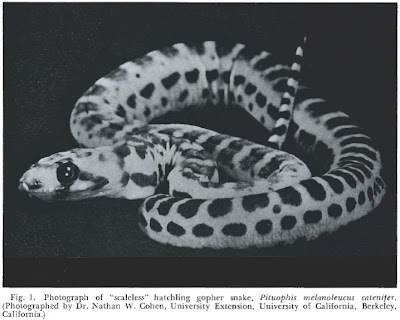 Photo Source
Shortly after that, a scaleless mole snake was captured in 1978. Following that came an Eastern garter snake in 1982. The most important observation made by the scientists was that they were captured in varying stages of maturity (hatchling to adult), and none were noted to be any more scarred than "normal" snakes captured from the same area. In 1985, Dr. H. Bernard Bechtel obtained a pair of scaleless Texas rat snakes from the Bronx Zoo. In 1990, he proved out the gene as simple recessive.
Another source
In the time that science has known of the scaleless mutation, multiple studies have been done to see if scaleless snakes dehydrate more quickly than their scaled kin. The short answer? No. No they do not. For a more in depth answer, and so you don't just have to take my word for it, here are a couple links to published studies:
A Scaleless Snake: Tests of the Role of Reptilian Scales in Water Loss and Heat Transfer, by Paul Licht and Albert F. Bennett
Evaporative water loss in scaleless snakes Albert F. Bennett and Paul Licht
Since then, the scaleless gene seems to be cropping up in many different species, especially those heavily propagated in captive breeding programs. Here are a few examples of some recently discovered scaleless specimens in a variety of species:
Corns

Texas rat snakes

Gopher snakes

Death adders

Burmese pythons

Hognoses
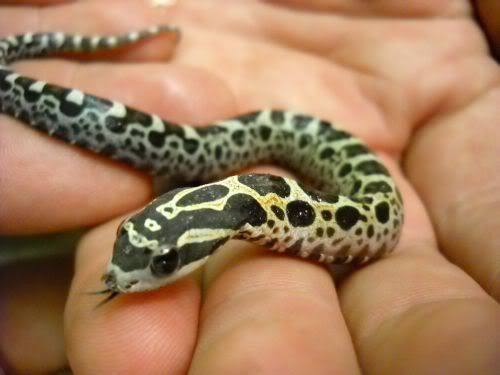
Rattlesnakes
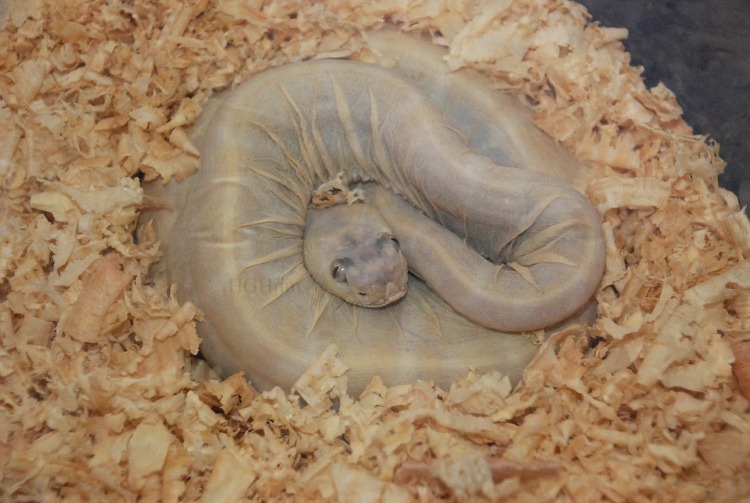
And many, many more.
In short, it has been proven that this gene is not lethal to the animal, and that wild specimens can survive, and even thrive. It is not an abomination, and is not something to stick your nose up at. You may not like them, and that's fine! No one is forcing you to. But before you bash something for being different, do a little research first. These are absolutely awesome little animals, and deserve the same respect that any other morph does.


 Scaleless Snakes: A Brief History


 Threaded Mode
