 11-13-12, 10:03 AM |
#29
|
|
Member
Join Date: Jan-2012
Posts: 636
Country: 
|
Re: Green bottle blue & rose hair tarantula
Quote:
Originally Posted by jaleely

also depends on the spider....It's the small shiny ones that give me the willies!!!!
|
Jumping spiders aren't fuzzy but even most nonarachnid folks do seem to find them quite cute.
Quote:
Originally Posted by jaleely
goliaths are awesome. we had one until it's first molt, and we didn't take good care of it and it died. we thought we were keeping it humid and warm enough, but apparently not.
|
You might have been doing everything alright, Melissa. Molting is a dangerous time for any arthropod and any number of things can go wrong. It could be that particular individual may have had other issues (even genetic problems) which played a role in its demise.
Quote:
Originally Posted by jaleely
But most of ours have lived out their lives. Some males (they age and then get the pedipulps..the mating "legs" and then die) have lived a long time...even one species, skeleton knee, having an extra molt and living a year longer past when his pedipalps showed up!
Our one mexican red knee is over 9 years old, i think.
|
If it has lived beyond 5 or 6 years, it's not a male. Male T's rarely make it past 5 years of age. With the long lived species like the red knees (B. smithii), males may make it to 6yrs but that is about it. After achieving their penultimate molt (sexual maturity) males typically die within a year. In some cases they may make it a bit past that but not by much.
Quote:
Originally Posted by jaleely
Maybe dragon will expand on the mating "legs"?
|
All T's and true spiders of both sexes have pedipalps -- what appear to be a set of smaller "legs" at the anterior of the cephalothorax. (In scorpions, the pedipalps are the pinchers for any who might be curious.) They are used somewhat like hands for the manipulation of objects.
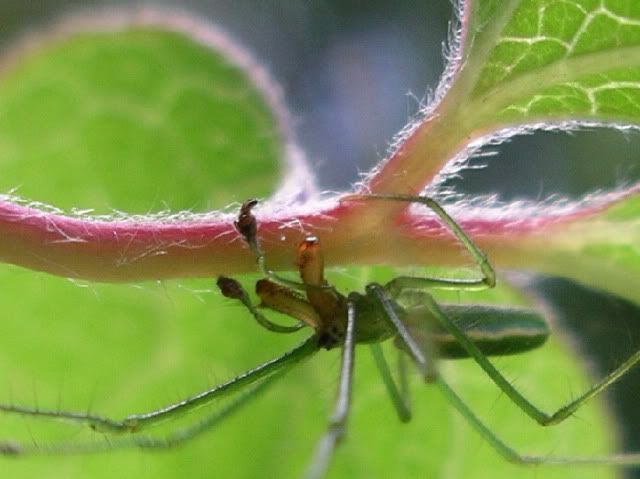
When males reach maturity, the distal segment of the pedipalp undergoes a transformation into an organ for the transmittal of sperm to the female. In many Ts and all true spiders, TBOMK, this segment becomes enlarged. (In true spiders, these enlarged segments are referred to as the male's "boxing gloves".)
-- Easily visible here in this male lynx spider
All mature male Ts and spiders also develop a needle like prominence (called an embolus) on this last segment -- it looks a bit like a fang. The male spins a sperm web, deposits a droplet of sperm on the web, and then repeatedly dips his emboli into the sperm droplet to fill them.
These are a couple of pics of my male P. irminia filling his emboli.
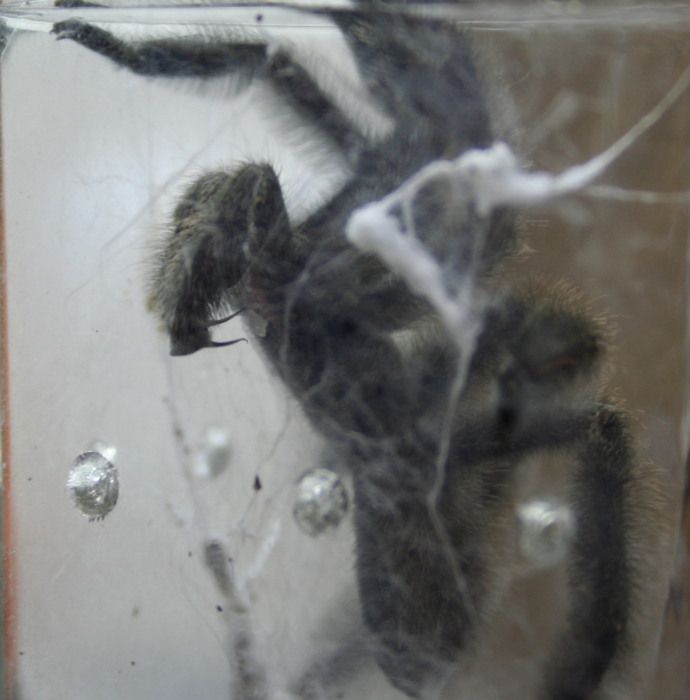
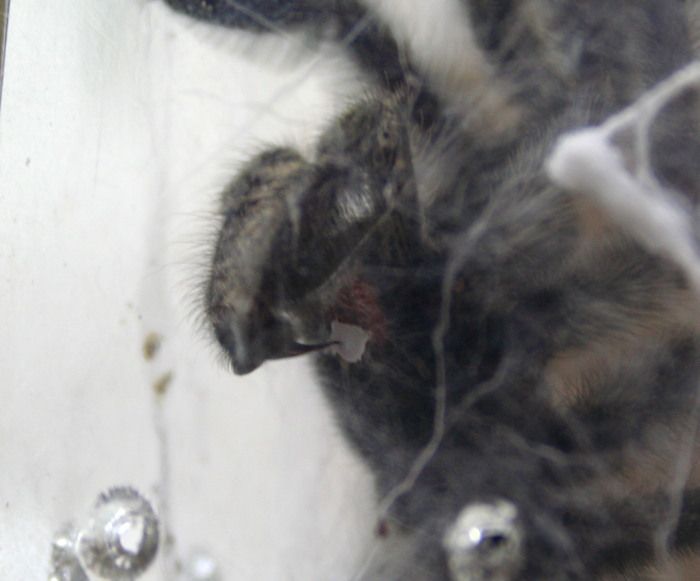 Upon finding a receptive female, he inserts an embolus into the female's genital area and deposits the sperm.
Quote:
Originally Posted by Roadtrash
When I was very young my father was bitten by a black widow when dressing one morning. It had gotten in the pants he had laid out to wear the next day and when he pulled them up it bit him in the nether regions if you will.
|
Situation really isn't any different than a snake or other animal biting someone who steps on it -- just a last ditch effort at self-preservation.
Quote:
Originally Posted by Rogue628
Wow
I was under the impression they weren't very friendly.
|
As with snakes and many herps, "friendly" is not the best word to use. It implies human feelings to something which definitely isn't (anthropomorphism)  As with any group of animals, there are always exceptions to the "rules of behavior". ( I have known people who owned "demonic" rose hair Ts ... the Ts apparently had not read the rose hair manual chapter about docility.) The biggest issue with T. blondi -- goliaths -- is not a tendency to bite but rather their urticating hairs. Their urt hairs are said to be among the most irritating such hairs with regards to their effect on humans.
__________________
change is the only constant
|

|
|




 Threaded Mode
